Showing posts with label African slavery in Qatar. Show all posts

Sunday, July 21, 2019

Revisiting Democratic Obama-Biden-Clinton Administration's 2011 War for Regime Change in Libya: Conclusion

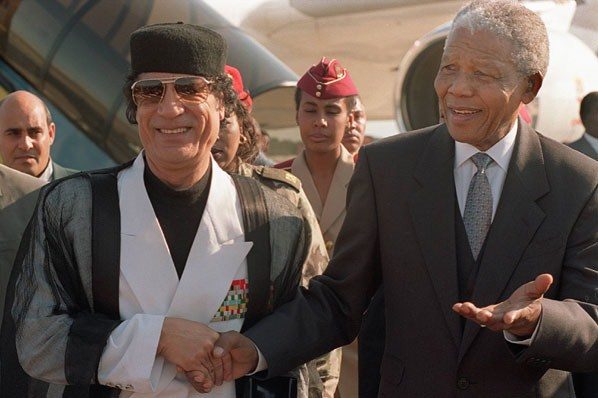
Nelson Mandela with Libyan government leader against whom Hawk Democrats launched 2011 war. 
The Democratic Obama-Biden-Clinton administration ended its Operation Odyssey Dawn overt military attack on Libya on March 31, 2011. But, along with other NATO government administrations, it continued to wage its overt war for regime change in Libya under the code name “Operation Unified Protector,” after Apr. 1, 2011.

So Libyan government leader Qaddafi then sent a letter on Apr. 6, 2011 to Democratic President Obama requesting that the Democratic Party leader put an end to NATO intervention in Libya.

But instead of agreeing to end U.S. military intervention in Libya, on Apr. 7, 2011 the Obama-Biden-Clinton administration again demanded that Qaddafi abdicate power and live in exile; and it continued to wage its war for regime change in Libya until Qaddafi was finally murdered on Oct. 20, 2011, in violation of international law.

According to the 2015 RAND Project Air Force Precision and Purpose study, during the Operation Unified Protector phase that began in early April 2011, “U.S. forces flew more than 7,100 total sorties…which represented nearly 27 percent of the total sorties during the” NATO “operation.” But, according to the Sowing Chaos: Libya In The Wake of Humanitarian Intervention book, “more than 2,000 residents” of the Libyan “city of Sirte,” were “killed in NATO air strikes;” and, by waging its war for regime change in Libya in 2011, “NATO handed over part of Libya’s territory to Al Qaida.”


In his 2016 Sowing Chaos: Libya In The Wake of Humanitarian Intervention book, Paolo Sensini noted that “the jury is still out as to whether the war on Libya was fought” by the Democratic Obama-Biden-Clinton administration “on behalf of fossil fuel interests or on behalf of banking interests.” But Sensini also observed that “by means of Obama’s Executive Order 13566,” Libyan financial assets  belonging to “the Central Bank of Libya (CBS), the Libyan Investment Authority (LIA), the Libya Foreign Bank, and the Libyan National Oil Company (LNOC)” were “frozen,” prior to the start of its Operation Odyssey Dawn military attack; and “in August 2011, President Obama confiscated $30 billion from Libya’s Central Bank, which Qaddafi had earmarked for the establishment of the African IMF and African Central Bank.”

What has been determined, though, is that the Libyan “rebels” who, with the military support of Democratic Party leaders (like Obama, Biden and Hillary Clinton), were finally able to overthrow the Qaddafi-led government by the fall of 2011, were apparently illegally armed and trained by government of Qatar. As the 2015 RAND Project Air Force Precision and Purpose study revealed:

“…The U.N…raised concerns about…Qatar making arms transfers in violation of the arms embargo…The U.N….was `clearly informed that several countries, including Qatar, were supporting the [Libyan] opposition through the deliveries of arms and ammunition.’…Between the beginning of the [Libyan] uprising and July 2011, `approximately 20 flights had delivered military material from Qatar to…[the opposition] in Libya, including French anti-tank weapon launchers (MILANs)…

“…Qatar had personnel on the ground in Benghazi training the opposition. Rebel forces openly remarked…how Qatar had been with them from the beginning.

“Operating in the range of 50 to 150 personnel on the ground at any one time, Qatar’s Special Forces (SF) were used to train the opposition in a variety of small arms and tactics…The SF provided…the means for rebel forces to successfully engage pro-Qaddafi forces. On the ground direct assistance…was conducted with the main rebel brigades. These advisory teams…provided the main link between rebel ground units and NATO’s air power…This was used to supplement NATO targeting…

“The first official admission of Qatar’s involvement in training the opposition forces came in late October [2011]…Qatari Chief of Staff of the Armed Forces Major-General Hamad bin Ali Al-Attiya remarked, `We were among them [the Libyan opposition forces] and the number of Qataris on the ground were hundreds in every region.’ He also noted that Qataris had been `running the training and communication operations’ and that `Qatar had supervised the rebels’ plans…`We acted as the link between the rebel and NATO forces.’…A team of 60 Qataris assisted the opposition in setting up command centers in Benghazi, Zintan, and Tripoli…Opposition forces were also flown back to Qatar for training…”

The pretext for launching the Democratic Obama-Biden-Clinton administration/NATO and Qatari governments’ 2011 “humanitarian military intervention” in Libya, despite the African Union’s March 11, 2011 call for no external foreign intervention in Libya, was that this war for regime change in Libya was needed to save the lives of Libyan civilians. Yet, as Seumas Milne observed in an op-ed column, titled “If The Libyan War Was About Saving Lives It Was A Catastrophic Failure,” that appeared in the Oct. 26, 2011 issue of the London Guardian, prior to the launching of the U.S./NATO’s “Operation Odyssey Dawn” on March 19, 2011 and “operation Unified Protector” after Apr. 1, 2011, “the death toll in Libya” was “perhaps around 1,000-2,000 (judging by U.N. estimates).” But, according to the same column, during the 8 months that followed the Democratic Obama-Biden-Clinton administration/NATO’s overt “humanitarian” military intervention in Libya, “as NATO leaders vetoed ceasefires and negotiations,” estimates of the numbers of new dead “range from 10,000 up to 50,000;” and “of these, uncounted thousands will be civilians, including those killed by NATO bombings and NATO-backed forces on the ground.”

In addition, in his Oct. 26, 2011 London Guardian column, Seumas Milne also, for example, noted:

“On Tuesday, Human Rights Watch reported the discovery of 53 bodies, military and civilian, in Qaddafi’s last stronghold of Sirte, apparently executed—with their hands tied—by former rebel militia.

“Its investigator in Libya, Peter Bouckaert, told me yesterday that more bodies are continuing to be discovered in Sirte, where evidence suggests about 500 people, civilians and fighters have been killed in the last 10 days alone by shooting, shelling and NATO bombing…

“That has followed a 2-month-long siege and indiscriminate bombing of a city of 100,000 which has been reduced to a Grozny-like state of destruction by newly triumphant rebel troops with NATO air and Special Forces support…

“…African migrants and black Libyans have been subject to a relentless racist campaign of mass detention, lynchings and atrocities on the usually unfounded basis that they have been loyalist mercenaries. Such attacks continue, says Bouckaert, who witnessed militias from Misrata this week burning homes in Tawerga so that the town’s predominately black population—accused of backing Qaddafi—will be unable to return…”

Nearly 5 years after Democratic Party leaders like Barack Obama, Joe Biden and Hillary Clinton launched their war for regime change in Libya, Chris Stephens noted in a Feb. 16, 2016 London Guardian article, titled “Five Years After Qaddafi, Libya’s Torn By Civil War And Battles With ISIS,” that “civil war” in Libya “has raged since the summer of 2014;” and “it is a war that has left 5,000 dead, the economy in ruins” and “half a million homeless.” So, not surprisingly, a Libyan medical student then told the London Guardian reporter that in Libya “some people say they want to go back to the time of Qaddafi.”

And as recently as July 9, 2019, even Al Jazeera now reported that “the battle between rival groups for the Libyan capital has killed more than 1,000 people since” April 2019, “the United Nations said;” and “the World Health Organization (WHO) said in a brief statement on Tuesday that 1,048 people, including 106 civilians, have been killed” in Libya since April 2019 and an additional 5,558 have been “wounded, including 289 civilians.” The same July 9, 2019 Al Jazeera article also noted that:

“Fighting has emptied entire neighborhoods of civilians. Thousands of African migrants captured by Libyan forces funded and trained by the European Union are trapped in detention centers near the front lines. An air raid on one facility last week killed more than 50 people mainly migrants held in a hangar that collapsed on top of them. Libya slid into chaos after the 2011 NATO-backed uprisings…”


2020 Democratic Party presidential primary candidate Sanders and 2016 Democratic Party presidential Nominee Clinton at 2016 Democratic National Convention
(end of article)

Friday, December 8, 2017

Al-Thani Family's Qatar History Revisited: Part 5


As the 2017 World Almanac and Book of Facts noted, "military ties" of the U.S. government with the Al-Thani absolute monarchical government in Qatar "have been expanding" and "Camp As-Sayliyah, a base near Doha" in Qatar, "served as a command center for the U.S.-led invasion of Iraq, March 2003." In addition, "a 10-year defense cooperation agreement" between the Democratic Obama administration and the Al-Thani regime was signed on December 10, 2013. Yet most people in the United States know little about the history of Qatar during the last few hundred years. For example:    

A high percentage of the people who live and work in Qatar have, historically, been foreign nationals rather than full Qatari citizens. As Rosemarie Said Zahlan noted in her 1979 book, The Creation of Qatar:

"Almost half of the population of Qatar immediately prior to the oil era were foreigners--Baharians,Iranians and Africans...The population, which stood at approximately 28,000 in 1939, had probably fallen to 25,000 during the years of World War II...In 1939 roughly half the population lived in Doha, the capital city...Roughly 39 percent of the entire (Qatari) population...in 1939 were foreigners. Of these, 6,000 were Negroes who had been originally slaves; rather than leave Qatar, they continued to live there...The number of Persians who settled in Qatar grew in the 1920s, and by 1939 there were an estimated 5,000 living in Qatar."

By 1977, 64 percent of Qatar's population were foreign national workers, a majority of whom were non-Arab foreigners, including 25,000 foreign workers from Pakistan. In 1970, 83 percent of all workers in Qatari were foreign workers.  According to the 2012 book by Georgia State University Professor of History Allen Fromherz, Qatar: A Modern History:

"...Qatar's population...is now at around 1.7 million, more than 80 per cent of which consists of expatriate workers from around the world, servants and employees of the relatively small...Qatari population of around 225,000...

"In 2009 there were more than 1.2 million males in Qatar compared with some 350,000 females. Most of these males are single...or married men who have left their families...Similarly, non-Qatari females are also predominantly single when in Qatar...The influx of expatriate labor only really began in Qatar in the late 1960s. By the late 1970s, however, the numbers were rapidly increasing...

"...Around 7 out of 8 workers were non-Qatari in 2007. Most laborers are men in their twenties and thirties from South Asia. The number of women brought to Qatar as expatriate workers is much lower...There were only about 30,000 Qataris in the early 1960s...Qatari labor sponsorship law...requires all non-Qataris to be sponsored by a Qatari citizens, who has control over their status, visa, conditions, salary, and potential expulsion..."

Tuesday, November 14, 2017

Al-Thani Family's Qatar History Revisited: Part 4


As the 2017 World Almanac and Book of Facts noted, "military ties" of the U.S. government with the Al-Thani absolute monarchical government in Qatar "have been expanding" and "Camp As-Sayliyah, a base near Doha" in Qatar, "served as a command center for the U.S.-led invasion of Iraq, March 2003." In addition, "a 10-year defense cooperation agreement" between the Democratic Obama administration and the Al-Thani regime was signed on December 10, 2013. Yet most people in the United States know little about the history of Qatar during the last few hundred years. For example:   

By the 1940s, the Al-Thani family in Qatar no longer was able to enrich itself by exporting pearls to foreign markets. As Rosemarie Said Zahlan's book The Creation of Qatar observed:

"The pearling...trade was dealt a crippling blow, from which it never recovered, in the 1930s. The international economic depression of 1929, which apparently decreased the demand for luxury items, coincided with introduction into world markets of the Japanese cultured pearl..."

But by granting UK imperialism's Anglo-Persian Oil Company [APOC] a concession in 1935 to exploit and profit from Qatar's then-undeveloped oil resources, the Al-Thani family member who held Qatar's emir position between  1913 and 1948, Abdullah Al-Thani, was able to more greatly enrich the Al-Thani family; as oil began to be discovered and then exported from Qatar after World War II. As Georgia State University Professor of History Allen Fromherz noted in Qatar: A Modern History, by the end of World War II: 

"The entire population of Qatar had fallen to 16,000. Entire villages that had survived for centuries were depopulated as tribes emigrated en masse to neighboring, more prosperous shores. In 1944 only 6,000 fishermen were engaged in the pearl harvest as opposed to 60,000 some 20 years before...

"...The 1916 treaty with Abdullah allowed the Anglo-Persian Oil Company [APOC] and the British government to make exclusive claims to potential oil deposits in Qatar. As the pearl industry declined in the 1920s Sheikh Abdullah...was eager to sign an oil agreement with APOC that would allow him to consolidate his position...By 1935...he finally signed the oil concession with APOC...Abdullah received a large payment of 400,000 Indian rupees upon signature of the agreement, with a further 150,000 to be paid to him personally each year. This amount was increased to $300,000 Indian rupees after the sixth year...A political agreement was also signed, securing British control over oil operations in Qatar and increasing British interference in Qatar's internal affairs. Shortly after the concession was signed by APOC, the company was transformed into an affiliate of the Iraq Petroleum Company, similarly controlled by the British, and renamed Petroleum Development Qatar Ltd., the predecessor to Qatar Petroleum..."

(end of part 4)


Thursday, November 9, 2017

Al-Thani Family's Qatar History Revisited: Part 2


As the 2017 World Almanac and Book of Facts noted, "military ties" of the U.S. government with the Al-Thani absolute monarchical government in Qatar "have been expanding" and "Camp As-Sayliyah, a base near Doha" in Qatar, "served as a command center for the U.S.-led invasion of Iraq, March 2003." In addition, "a 10-year defense cooperation agreement" between the Democratic Obama administration and the Al-Thani regime was signed on December 10, 2013. Yet most people in the United States know little about the history of Qatar during the last few hundred years. For example:

During the pre-World War II historical era of the Al-Thani family's absolute monarchical rule in Qatar, when only the export of pearls was then Qatar's chief money-making export business operation, many of the people who lived in Qatar were slaves of East African family background; and slavery continued to exist in Qatar as late as the 1950s. As Georgia State University Professor of History Allen Fromherz noted in his 2012 book Qatar: A Modern History, "little discussed in Qatar today, slavery existed in Qatar well into the twentieth century" and "it was not until the 1950s that all slaves were manumitted..." In her 1979 book, The Creation of Qatar, Rosemarie Said Zahlan also recalled: 

"...Another large segment of the population were the negroes, descendants of the slaves who had been brought to the Gulf from East Africa during the 19th-century. Over the years, one-third of them had been able to buy their own manumission, primarily through their work in pearling. The rest remained enslaved until the middle of the present [20th] century...Today [in 1979] they are...considered as Qataris...Qatar had an extremely scanty supply of fresh water and consequently could not rely on even a subsistence level of agriculture. The only resource was the sea. It was from the sea that Qataris made their living, exporting their one precious commodity, the pearl.

"The pearling industry was the pivotal point of the economic and social structure of Qatar...The ruler levied a tax on the pearl ships, which, together with customs duties, formed the basis of his revenue...The entire male population probably left the main towns for the pearling banks during the season...

"...Qatar had a large African-population, two-thirds of whom were slaves...Almost half of the pearling population of Qatar were negroes, either slaves or former slaves; it is clear, therefore, that without this substantial addition to the population, the pearling fleet and its products would have been considerably less. Although household slaves also existed, their exact number is difficult to ascertain because they gradually became a part of the families they worked for...

(end of part 2)